Common Green Bottle Fly
ALL PHOTOS, Insects — August 9, 2010 at 6:12 am | 8 comments |
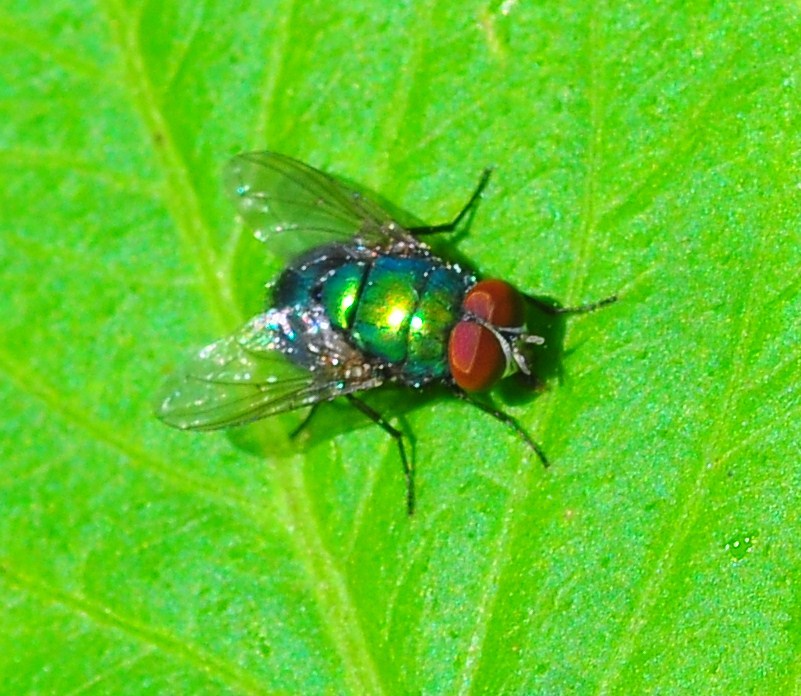
This is a photograph of a Common Green Bottle FlyTrue flies are insects of the order Diptera (di = two, and ptera = wings). They possess a pair of wings on the mesothorax and a pair of halteres, derived from the hind wings, on the metathorax.
The presence of a single pair of wings distinguishes true flies from other insects with "fly" in their name, such as mayflies, dragonflies, damselflies, stoneflies, whiteflies, fireflies, alderflies, dobsonflies, snakeflies, sawflies, caddisflies, butterflies or scorpionflies. Some true flies have become secondarily wingless, especially in the superfamily Hippoboscoidea, or among those that are inquilines in social insect colonies.
Diptera is a large order, containing an estimated 240,000 species of mosquitoes, gnats, midges and others, although under half of these (about 120,000 species) have been described. It is one of the major insect orders both in terms of ecological and human (medical and economic) importance. The Diptera, in particular the mosquitoes (Culicidae), are of great importance as disease transmitters, acting as vectors for malaria, dengue, West Nile virus, yellow fever, encephalitis and other infectious diseases. taken at Arch Creek Memorial Park, using a Nikon D90 and Nikkor 60mm lens.
The common green bottle flyTrue flies are insects of the order Diptera (di = two, and ptera = wings). They possess a pair of wings on the mesothorax and a pair of halteres, derived from the hind wings, on the metathorax.
The presence of a single pair of wings distinguishes true flies from other insects with "fly" in their name, such as mayflies, dragonflies, damselflies, stoneflies, whiteflies, fireflies, alderflies, dobsonflies, snakeflies, sawflies, caddisflies, butterflies or scorpionflies. Some true flies have become secondarily wingless, especially in the superfamily Hippoboscoidea, or among those that are inquilines in social insect colonies.
Diptera is a large order, containing an estimated 240,000 species of mosquitoes, gnats, midges and others, although under half of these (about 120,000 species) have been described. It is one of the major insect orders both in terms of ecological and human (medical and economic) importance. The Diptera, in particular the mosquitoes (Culicidae), are of great importance as disease transmitters, acting as vectors for malaria, dengue, West Nile virus, yellow fever, encephalitis and other infectious diseases. (Lucilia sericata) is a common blow-flyTrue flies are insects of the order Diptera (di = two, and ptera = wings). They possess a pair of wings on the mesothorax and a pair of halteres, derived from the hind wings, on the metathorax.
The presence of a single pair of wings distinguishes true flies from other insects with "fly" in their name, such as mayflies, dragonflies, damselflies, stoneflies, whiteflies, fireflies, alderflies, dobsonflies, snakeflies, sawflies, caddisflies, butterflies or scorpionflies. Some true flies have become secondarily wingless, especially in the superfamily Hippoboscoidea, or among those that are inquilines in social insect colonies.
Diptera is a large order, containing an estimated 240,000 species of mosquitoes, gnats, midges and others, although under half of these (about 120,000 species) have been described. It is one of the major insect orders both in terms of ecological and human (medical and economic) importance. The Diptera, in particular the mosquitoes (Culicidae), are of great importance as disease transmitters, acting as vectors for malaria, dengue, West Nile virus, yellow fever, encephalitis and other infectious diseases. found in most areas of the world, and the most well-known of the numerous green bottle flyTrue flies are insects of the order Diptera (di = two, and ptera = wings). They possess a pair of wings on the mesothorax and a pair of halteres, derived from the hind wings, on the metathorax.
The presence of a single pair of wings distinguishes true flies from other insects with "fly" in their name, such as mayflies, dragonflies, damselflies, stoneflies, whiteflies, fireflies, alderflies, dobsonflies, snakeflies, sawflies, caddisflies, butterflies or scorpionflies. Some true flies have become secondarily wingless, especially in the superfamily Hippoboscoidea, or among those that are inquilines in social insect colonies.
Diptera is a large order, containing an estimated 240,000 species of mosquitoes, gnats, midges and others, although under half of these (about 120,000 species) have been described. It is one of the major insect orders both in terms of ecological and human (medical and economic) importance. The Diptera, in particular the mosquitoes (Culicidae), are of great importance as disease transmitters, acting as vectors for malaria, dengue, West Nile virus, yellow fever, encephalitis and other infectious diseases. species. It is 10–14 mm long, slightly larger than a housefly, and has brilliant, metallic, blue-green or golden coloration with black markings. It has black bristle-like hair and three cross-grooves on the thorax. The wings are clear with light brown veins, and the legs and antennae are black. The maggots (larvae) of the flyTrue flies are insects of the order Diptera (di = two, and ptera = wings). They possess a pair of wings on the mesothorax and a pair of halteres, derived from the hind wings, on the metathorax.
The presence of a single pair of wings distinguishes true flies from other insects with "fly" in their name, such as mayflies, dragonflies, damselflies, stoneflies, whiteflies, fireflies, alderflies, dobsonflies, snakeflies, sawflies, caddisflies, butterflies or scorpionflies. Some true flies have become secondarily wingless, especially in the superfamily Hippoboscoidea, or among those that are inquilines in social insect colonies.
Diptera is a large order, containing an estimated 240,000 species of mosquitoes, gnats, midges and others, although under half of these (about 120,000 species) have been described. It is one of the major insect orders both in terms of ecological and human (medical and economic) importance. The Diptera, in particular the mosquitoes (Culicidae), are of great importance as disease transmitters, acting as vectors for malaria, dengue, West Nile virus, yellow fever, encephalitis and other infectious diseases. are used for maggot therapy. L. sericata is common all over the world, mainly the southern hemisphere, dominating in Africa and Australia.
The Common Green Bottle FlyTrue flies are insects of the order Diptera (di = two, and ptera = wings). They possess a pair of wings on the mesothorax and a pair of halteres, derived from the hind wings, on the metathorax.
The presence of a single pair of wings distinguishes true flies from other insects with "fly" in their name, such as mayflies, dragonflies, damselflies, stoneflies, whiteflies, fireflies, alderflies, dobsonflies, snakeflies, sawflies, caddisflies, butterflies or scorpionflies. Some true flies have become secondarily wingless, especially in the superfamily Hippoboscoidea, or among those that are inquilines in social insect colonies.
Diptera is a large order, containing an estimated 240,000 species of mosquitoes, gnats, midges and others, although under half of these (about 120,000 species) have been described. It is one of the major insect orders both in terms of ecological and human (medical and economic) importance. The Diptera, in particular the mosquitoes (Culicidae), are of great importance as disease transmitters, acting as vectors for malaria, dengue, West Nile virus, yellow fever, encephalitis and other infectious diseases. is coastal in its distribution and prefers warm and moist climates. The female will lay her eggs in meat, fish, animal corpses, infected wounds of humans or animals, and excrement. The larvae of this insect feed on most decomposing tissue, but seem to concentrate on the Ovis genus which cause many problems for sheep farmers. This insect is also typical to most flyTrue flies are insects of the order Diptera (di = two, and ptera = wings). They possess a pair of wings on the mesothorax and a pair of halteres, derived from the hind wings, on the metathorax.
The presence of a single pair of wings distinguishes true flies from other insects with "fly" in their name, such as mayflies, dragonflies, damselflies, stoneflies, whiteflies, fireflies, alderflies, dobsonflies, snakeflies, sawflies, caddisflies, butterflies or scorpionflies. Some true flies have become secondarily wingless, especially in the superfamily Hippoboscoidea, or among those that are inquilines in social insect colonies.
Diptera is a large order, containing an estimated 240,000 species of mosquitoes, gnats, midges and others, although under half of these (about 120,000 species) have been described. It is one of the major insect orders both in terms of ecological and human (medical and economic) importance. The Diptera, in particular the mosquitoes (Culicidae), are of great importance as disease transmitters, acting as vectors for malaria, dengue, West Nile virus, yellow fever, encephalitis and other infectious diseases. species by having three instar stages, a pre-pupa stage, and a pupa stage.
Subject Photo exif Data

Related posts:
- Gulf Fritillary Butterfly and Caterpillar
- Florida Leaf-Footed Bug in Big Cypress
- Dragonfly Smile at Big Cypress WMA
- Assassin Bug in Florida Everglades
- Halloween Pennant Dragonfly
Tags: Bottle fly, Insects, macrophotography
8 Comments
Used to share my lunch with these things in the Deli on Neptune Avenue
Fluke fishing was always slow and boring, lay on the deck on the Tampa and fry in the sun,and get eaten alive by pesky flies. Maybe catch a few fluke. I would go for fluke when my arms were tired from bluefishing.
Wow, what a guy! lol
that's just it, there is no point. I'm pushin 60
And your point is????????????????????
No excuse..I'm pushin 59. Does dementia begin at 60? lol
I\’m totally jealous of your work!
This is such amazing photography