BIG CYPRESS NWR (Part 1)
January 1998
clear sky, 70 degrees, wind NE
FIRST TIME AT BIG CYPRESS NWR 1998 (Part One)
That magic weekend was rapidly approaching. Long awaited. Long overdue. I decided that the directions, as poor as they were, were better than nothing! My newest exploratory spot was to be Big Cypress National Wildlife Reserve in the Florida Everglades. I googled this place to get some stats on it, and maybe a map. I quickly found out that this Wildlife Management Area was 729,000 acres! That’s a hell of a lot of acreage by anyone’s standards. I was certainly impressed. My directions were to get on I-95 till I reached I-595. I was then to stay on this highway until I saw a sign that said “To Naples” and stay on it until I have to pay a toll. After that, it’s I-75. Alligator Alley all the way to Collier County! Approximately ½ hour later, I was to locate a blue Rest Stop sign, and get off at its entrance, and proceed to the Stop. I parked my car and went forth. Only the directions said to backtrack along the service road fence until I see a special one way opening door, along the fence line.
About a quarter mile later I found the entrance in. I was psyched with excitement and anticipation of what lay ahead. And that little adrenalin high when you made a discovery.
Now where’s my darn camera?
It is said “A journey begins with that first step”
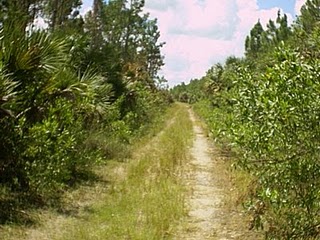
I open the narrow spring loaded door and step inside. The door instantly snaps shut behind me. I gaze down a “road” that was cut from massive coral beds. It goes down a few hundred yards and then bends off to the left before disappearing in the foliage. I walk to the bend to see where it might lead. Just before getting to the bend, a family of armadillo crossed my path. They look like armor plated rodents with pig noses! They were actually quite cute critters. As soon as they heard the Velcro ripping sound as I tried to get at my camera to snap away, they made a sharp right and disappeared into the growth. Next, a Great Blue HeronThe herons are long-legged freshwater and coastal birds in the Ardeidae family. There are 64 recognised species in this family. Some are called egrets or bitterns instead of herons. Within the family, all members of the genera Botaurus and Ixobrychus are referred to as bitterns, and—including the Zigzag Heron or Zigzag Bittern—are a monophyletic group within the Ardeidae. However, egrets are not a biologically distinct group from the herons, and tend to be named differently because they are mainly white and/or have decorative plumes. Although egrets have the same build as the larger herons, they tend to be smaller.
The classification of the individual heron/egret species is fraught with difficulty, and there is still no clear consensus about the correct placement of many species into either of the two major genera, Ardea and Egretta. Similarly, the relationship of the genera in the family is not completely resolved. However, one species formerly considered to constitute a separate monotypic family Cochlearidae, the Boat-billed Heron, is now regarded as a member of the Ardeidae.
Although herons resemble birds in some other families, such as the storks, ibises and spoonbills, they differ from these in flying with their necks retracted, not outstretched. They are also one of the bird groups that have powder down.
Some members of this group nest colonially in trees; others, notably the bitterns, use reedbeds.
, flying above a long canal parallel to the road, didn’t appreciate the disturbance in their neck of the woods either, starting making loud sounds. I mean this is a big birdBirds (class Aves) are feathered, winged, bipedal, endothermic (warm-blooded), egg-laying, vertebrate animals. Around 10,000 living species makes them the most speciose class of tetrapod vertebrates. They inhabit ecosystems across the globe, from the Arctic to the Antarctic. Extant birds range in size from the 5 cm (2 in) BeeBees are flying insects closely related to wasps and ants, and are known for their role in pollination and for producing honey and beeswax. Bees are a monophyletic lineage within the superfamily Apoidea, presently classified by the unranked taxon name Anthophila. There are nearly 20,000 known species of bees in seven to nine recognized families,[1] though many are undescribed and the actual number is probably higher. They are found on every continent except Antarctica, in every habitat on the planet that contains insect-pollinated flowering plants.
Bees are adapted for feeding on nectar and pollen, the former primarily as an energy source and the latter primarily for protein and other nutrients. Most pollen is used as food for larvae.
Bees have a long proboscis (a complex "tongue") that enables them to obtain the nectar from flowers. They have antennae almost universally made up of 13 segments in males and 12 in females, as is typical for the superfamily. Bees all have two pairs of wings, the hind pair being the smaller of the two; in a very few species, one sex or caste has relatively short wings that make flight difficult or impossible, but none are wingless.
Hummingbird to the 2.75 m (9 ft) Ostrich. The fossil record indicates birds evolved from theropod dinosaurs during the Jurassic period, around 150–200 million years (Ma) ago, and the earliest known bird is the Late Jurassic Archaeopteryx, around 150–145 Mya (million years ago). Most paleontologists regard birds as the only clade of dinosaurs to have survived the Cretaceous–Tertiary extinction event approximately 65.5 Mya.
Modern birds are characterised by feathers, a beak with no teeth, the laying of hard-shelled eggs, a high metabolic rate, a four-chambered heart, and a lightweight but strong skeleton. All living species of birds have wings—the now extinct flightless Moa of New Zealand was the only exception. Wings are evolved forelimbs, and most bird species can flyTrue flies are insects of the order Diptera (di = two, and ptera = wings). They possess a pair of wings on the mesothorax and a pair of halteres, derived from the hind wings, on the metathorax.
The presence of a single pair of wings distinguishes true flies from other insects with "fly" in their name, such as mayflies, dragonflies, damselflies, stoneflies, whiteflies, fireflies, alderflies, dobsonflies, snakeflies, sawflies, caddisflies, butterflies or scorpionflies. Some true flies have become secondarily wingless, especially in the superfamily Hippoboscoidea, or among those that are inquilines in social insect colonies.
Diptera is a large order, containing an estimated 240,000 species of mosquitoes, gnats, midges and others, although under half of these (about 120,000 species) have been described. It is one of the major insect orders both in terms of ecological and human (medical and economic) importance. The Diptera, in particular the mosquitoes (Culicidae), are of great importance as disease transmitters, acting as vectors for malaria, dengue, West Nile virus, yellow fever, encephalitis and other infectious diseases., with some exceptions, including ratites, penguins, and a number of diverse endemic island species. Birds also have unique digestive and respiratory systems that are highly adapted for flight. Some birds, especially corvids and parrots, are among the most intelligent animal species; a number of bird species have been observed manufacturing and using tools, and many social species exhibit cultural transmission of knowledge across generations. with a wingspan of 6 feet! It seemed like it was warning all that a newcomer was present. Next, I see a white tail deer, a doe run off. You have to understand, this is a new place for me to explore. And I’ve only gotten to a bend in the road. And there is such abundant wildlife here. I think it will take years to really understand this beautiful area. It’s so worth it! The road goes on and on until it becomes just a blur with a canal on one side and the woods on the other.
Reminder to me: Get a GPS because nobody is gonna find me if I get lost!
My first impression of this new place…Holy Crap! It’s HUGE! I’m impressed.
OK, it took me an hour to get from my home to here…Real Wilderness. I found it and it’s mine!
Now the next trip (hopefully the following weekend), I’ll be back equipped for what lies ahead. This was a good first trip! At least I found the place! Hidden away from the masses of prying eyes, devoid of human sound. I might move here! Permanently! Lol
Important note:
Bring a lot of bottled water or a hydration pack. The humidity was extremely high and you WILL sweat. A lot! Oh yeah, and a hell of a lot of mosquito spray. Trust me !
I can’t wait to come back here and really start exploring! It’s going to be a long week!
2 Comments
Sounds like the start of a real adventure, Alan.
All the best from Santiago de Chile…
Thank you Andrew