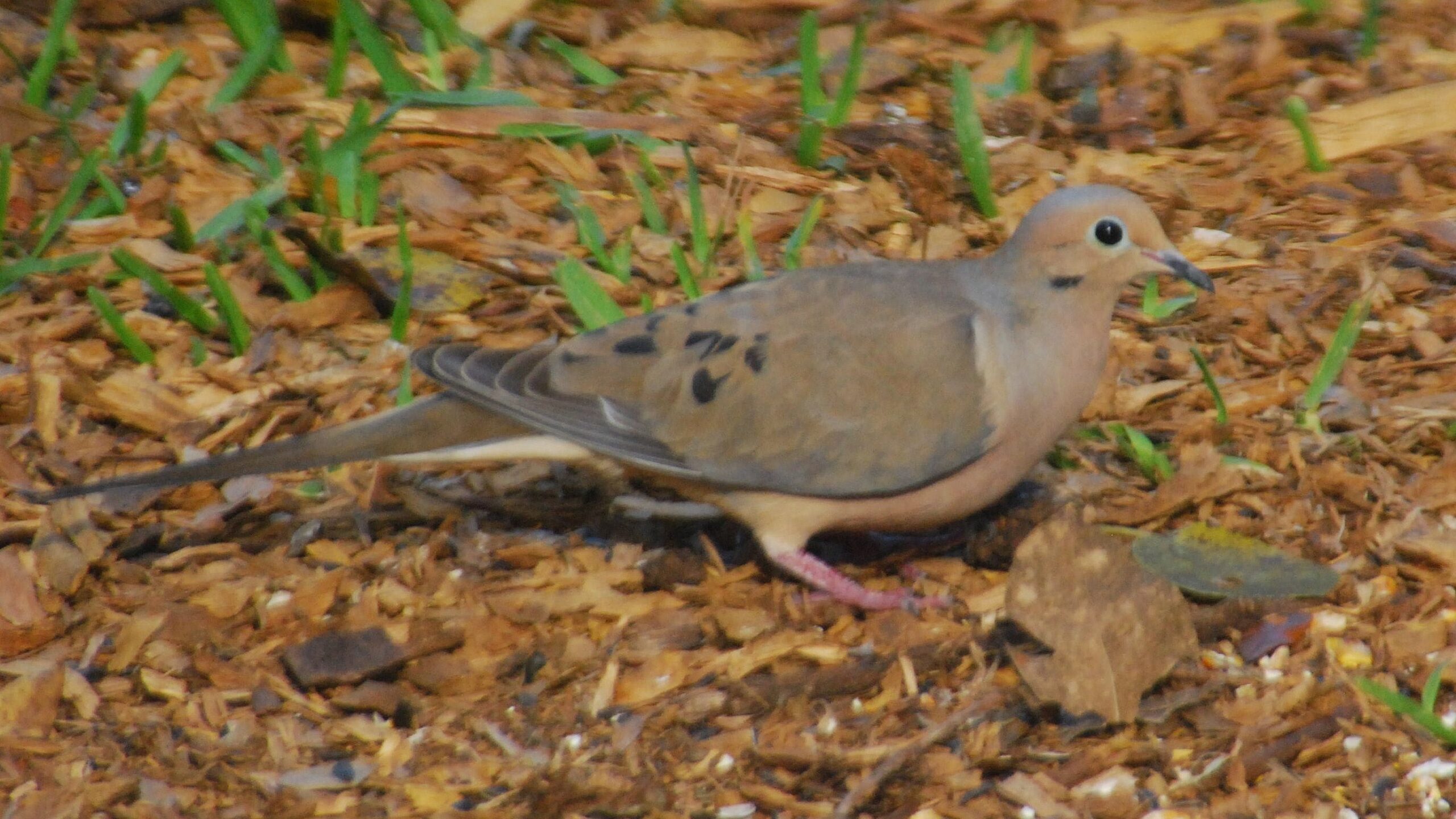
Mourning Dove at Enchanted Forest Park
ALL PHOTOS, Birds, ENCHANTED FOREST — August 17, 2010 at 6:21 am | 6 comments |
- other sizes:
- 800 x 600
- 1280 x 1024
- original size
Photo of a Mourning DovePigeons and doves constitute the birdBirds (class Aves) are feathered, winged, bipedal, endothermic (warm-blooded), egg-laying, vertebrate animals. Around 10,000 living species makes them the most speciose class of tetrapod vertebrates. They inhabit ecosystems across the globe, from the Arctic to the Antarctic. Extant birds range in size from the 5 cm (2 in) BeeBees are flying insects closely related to wasps and ants, and are known for their role in pollination and for producing honey and beeswax. Bees are a monophyletic lineage within the superfamily Apoidea, presently classified by the unranked taxon name Anthophila. There are nearly 20,000 known species of bees in seven to nine recognized families,[1] though many are undescribed and the actual number is probably higher. They are found on every continent except Antarctica, in every habitat on the planet that contains insect-pollinated flowering plants. Bees are adapted for feeding on nectar and pollen, the former primarily as an energy source and the latter primarily for protein and other nutrients. Most pollen is used as food for larvae. Bees have a long proboscis (a complex "tongue") that enables them to obtain the nectar from flowers. They have antennae almost universally made up of 13 segments in males and 12 in females, as is typical for the superfamily. Bees all have two pairs of wings, the hind pair being the smaller of the two; in a very few species, one sex or caste has relatively short wings that make flight difficult or impossible, but none are wingless. Hummingbird to the 2.75 m (9 ft) Ostrich. The fossil record indicates birds evolved from theropod dinosaurs during the Jurassic period, around 150–200 million years (Ma) ago, and the earliest known bird is the Late Jurassic Archaeopteryx, around 150–145 Mya (million years ago). Most paleontologists regard birds as the only clade of dinosaurs to have survived the Cretaceous–Tertiary extinction event approximately 65.5 Mya. Modern birds are characterised by feathers, a beak with no teeth, the laying of hard-shelled eggs, a high metabolic rate, a four-chambered heart, and a lightweight but strong skeleton. All living species of birds have wings—the now extinct flightless Moa of New Zealand was the only exception. Wings are evolved forelimbs, and most bird species can flyTrue flies are insects of the order Diptera (di = two, and ptera = wings). They possess a pair of wings on the mesothorax and a pair of halteres, derived from the hind wings, on the metathorax. The presence of a single pair of wings distinguishes true flies from other insects with "fly" in their name, such as mayflies, dragonflies, damselflies, stoneflies, whiteflies, fireflies, alderflies, dobsonflies, snakeflies, sawflies, caddisflies, butterflies or scorpionflies. Some true flies have become secondarily wingless, especially in the superfamily Hippoboscoidea, or among those that are inquilines in social insect colonies. Diptera is a large order, containing an estimated 240,000 species of mosquitoes, gnats, midges and others, although under half of these (about 120,000 species) have been described. It is one of the major insect orders both in terms of ecological and human (medical and economic) importance. The Diptera, in particular the mosquitoes (Culicidae), are of great importance as disease transmitters, acting as vectors for malaria, dengue, West Nile virus, yellow fever, encephalitis and other infectious diseases., with some exceptions, including ratites, penguins, and a number of diverse endemic island species. Birds also have unique digestive and respiratory systems that are highly adapted for flight. Some birds, especially corvids and parrots, are among the most intelligent animal species; a number of bird species have been observed manufacturing and using tools, and many social species exhibit cultural transmission of knowledge across generations. family Columbidae within the order Columbiformes, which include some 300 species of near passerines. In general terms "dove" and "pigeon" are used somewhat interchangeably. In ornithological practice, there is a tendency for "dove" to be used for smaller species and "pigeon" for larger ones, but this is in no way consistently applied, and historically the common names for these birds involve a great deal of variation between the terms "dove" and "pigeon." This family occurs worldwide, but the greatest variety is in the Indomalaya and Australasia ecozones. Young doves and pigeons are called "squabs." Pigeons and doves are stout-bodied birds with short necks, and have short slender bills with a fleshy cere. The species commonly referred to just as "pigeon" is the feral Rock Pigeon, common in many cities. taken at Enchanted Forest Park. Camera used for the picture was a Nikon D80 with a Tamron 28-300mm lens..
The Mourning DovePigeons and doves constitute the birdBirds (class Aves) are feathered, winged, bipedal, endothermic (warm-blooded), egg-laying, vertebrate animals. Around 10,000 living species makes them the most speciose class of tetrapod vertebrates. They inhabit ecosystems across the globe, from the Arctic to the Antarctic. Extant birds range in size from the 5 cm (2 in) BeeBees are flying insects closely related to wasps and ants, and are known for their role in pollination and for producing honey and beeswax. Bees are a monophyletic lineage within the superfamily Apoidea, presently classified by the unranked taxon name Anthophila. There are nearly 20,000 known species of bees in seven to nine recognized families,[1] though many are undescribed and the actual number is probably higher. They are found on every continent except Antarctica, in every habitat on the planet that contains insect-pollinated flowering plants. Bees are adapted for feeding on nectar and pollen, the former primarily as an energy source and the latter primarily for protein and other nutrients. Most pollen is used as food for larvae. Bees have a long proboscis (a complex "tongue") that enables them to obtain the nectar from flowers. They have antennae almost universally made up of 13 segments in males and 12 in females, as is typical for the superfamily. Bees all have two pairs of wings, the hind pair being the smaller of the two; in a very few species, one sex or caste has relatively short wings that make flight difficult or impossible, but none are wingless. Hummingbird to the 2.75 m (9 ft) Ostrich. The fossil record indicates birds evolved from theropod dinosaurs during the Jurassic period, around 150–200 million years (Ma) ago, and the earliest known bird is the Late Jurassic Archaeopteryx, around 150–145 Mya (million years ago). Most paleontologists regard birds as the only clade of dinosaurs to have survived the Cretaceous–Tertiary extinction event approximately 65.5 Mya. Modern birds are characterised by feathers, a beak with no teeth, the laying of hard-shelled eggs, a high metabolic rate, a four-chambered heart, and a lightweight but strong skeleton. All living species of birds have wings—the now extinct flightless Moa of New Zealand was the only exception. Wings are evolved forelimbs, and most bird species can flyTrue flies are insects of the order Diptera (di = two, and ptera = wings). They possess a pair of wings on the mesothorax and a pair of halteres, derived from the hind wings, on the metathorax. The presence of a single pair of wings distinguishes true flies from other insects with "fly" in their name, such as mayflies, dragonflies, damselflies, stoneflies, whiteflies, fireflies, alderflies, dobsonflies, snakeflies, sawflies, caddisflies, butterflies or scorpionflies. Some true flies have become secondarily wingless, especially in the superfamily Hippoboscoidea, or among those that are inquilines in social insect colonies. Diptera is a large order, containing an estimated 240,000 species of mosquitoes, gnats, midges and others, although under half of these (about 120,000 species) have been described. It is one of the major insect orders both in terms of ecological and human (medical and economic) importance. The Diptera, in particular the mosquitoes (Culicidae), are of great importance as disease transmitters, acting as vectors for malaria, dengue, West Nile virus, yellow fever, encephalitis and other infectious diseases., with some exceptions, including ratites, penguins, and a number of diverse endemic island species. Birds also have unique digestive and respiratory systems that are highly adapted for flight. Some birds, especially corvids and parrots, are among the most intelligent animal species; a number of bird species have been observed manufacturing and using tools, and many social species exhibit cultural transmission of knowledge across generations. family Columbidae within the order Columbiformes, which include some 300 species of near passerines. In general terms "dove" and "pigeon" are used somewhat interchangeably. In ornithological practice, there is a tendency for "dove" to be used for smaller species and "pigeon" for larger ones, but this is in no way consistently applied, and historically the common names for these birds involve a great deal of variation between the terms "dove" and "pigeon." This family occurs worldwide, but the greatest variety is in the Indomalaya and Australasia ecozones. Young doves and pigeons are called "squabs." Pigeons and doves are stout-bodied birds with short necks, and have short slender bills with a fleshy cere. The species commonly referred to just as "pigeon" is the feral Rock Pigeon, common in many cities. (Zenaida macroura) is a member of the dovePigeons and doves constitute the birdBirds (class Aves) are feathered, winged, bipedal, endothermic (warm-blooded), egg-laying, vertebrate animals. Around 10,000 living species makes them the most speciose class of tetrapod vertebrates. They inhabit ecosystems across the globe, from the Arctic to the Antarctic. Extant birds range in size from the 5 cm (2 in) BeeBees are flying insects closely related to wasps and ants, and are known for their role in pollination and for producing honey and beeswax. Bees are a monophyletic lineage within the superfamily Apoidea, presently classified by the unranked taxon name Anthophila. There are nearly 20,000 known species of bees in seven to nine recognized families,[1] though many are undescribed and the actual number is probably higher. They are found on every continent except Antarctica, in every habitat on the planet that contains insect-pollinated flowering plants. Bees are adapted for feeding on nectar and pollen, the former primarily as an energy source and the latter primarily for protein and other nutrients. Most pollen is used as food for larvae. Bees have a long proboscis (a complex "tongue") that enables them to obtain the nectar from flowers. They have antennae almost universally made up of 13 segments in males and 12 in females, as is typical for the superfamily. Bees all have two pairs of wings, the hind pair being the smaller of the two; in a very few species, one sex or caste has relatively short wings that make flight difficult or impossible, but none are wingless. Hummingbird to the 2.75 m (9 ft) Ostrich. The fossil record indicates birds evolved from theropod dinosaurs during the Jurassic period, around 150–200 million years (Ma) ago, and the earliest known bird is the Late Jurassic Archaeopteryx, around 150–145 Mya (million years ago). Most paleontologists regard birds as the only clade of dinosaurs to have survived the Cretaceous–Tertiary extinction event approximately 65.5 Mya. Modern birds are characterised by feathers, a beak with no teeth, the laying of hard-shelled eggs, a high metabolic rate, a four-chambered heart, and a lightweight but strong skeleton. All living species of birds have wings—the now extinct flightless Moa of New Zealand was the only exception. Wings are evolved forelimbs, and most bird species can flyTrue flies are insects of the order Diptera (di = two, and ptera = wings). They possess a pair of wings on the mesothorax and a pair of halteres, derived from the hind wings, on the metathorax. The presence of a single pair of wings distinguishes true flies from other insects with "fly" in their name, such as mayflies, dragonflies, damselflies, stoneflies, whiteflies, fireflies, alderflies, dobsonflies, snakeflies, sawflies, caddisflies, butterflies or scorpionflies. Some true flies have become secondarily wingless, especially in the superfamily Hippoboscoidea, or among those that are inquilines in social insect colonies. Diptera is a large order, containing an estimated 240,000 species of mosquitoes, gnats, midges and others, although under half of these (about 120,000 species) have been described. It is one of the major insect orders both in terms of ecological and human (medical and economic) importance. The Diptera, in particular the mosquitoes (Culicidae), are of great importance as disease transmitters, acting as vectors for malaria, dengue, West Nile virus, yellow fever, encephalitis and other infectious diseases., with some exceptions, including ratites, penguins, and a number of diverse endemic island species. Birds also have unique digestive and respiratory systems that are highly adapted for flight. Some birds, especially corvids and parrots, are among the most intelligent animal species; a number of bird species have been observed manufacturing and using tools, and many social species exhibit cultural transmission of knowledge across generations. family Columbidae within the order Columbiformes, which include some 300 species of near passerines. In general terms "dove" and "pigeon" are used somewhat interchangeably. In ornithological practice, there is a tendency for "dove" to be used for smaller species and "pigeon" for larger ones, but this is in no way consistently applied, and historically the common names for these birds involve a great deal of variation between the terms "dove" and "pigeon." This family occurs worldwide, but the greatest variety is in the Indomalaya and Australasia ecozones. Young doves and pigeons are called "squabs." Pigeons and doves are stout-bodied birds with short necks, and have short slender bills with a fleshy cere. The species commonly referred to just as "pigeon" is the feral Rock Pigeon, common in many cities. family (Columbidae). The birdBirds (class Aves) are feathered, winged, bipedal, endothermic (warm-blooded), egg-laying, vertebrate animals. Around 10,000 living species makes them the most speciose class of tetrapod vertebrates. They inhabit ecosystems across the globe, from the Arctic to the Antarctic. Extant birds range in size from the 5 cm (2 in) BeeBees are flying insects closely related to wasps and ants, and are known for their role in pollination and for producing honey and beeswax. Bees are a monophyletic lineage within the superfamily Apoidea, presently classified by the unranked taxon name Anthophila. There are nearly 20,000 known species of bees in seven to nine recognized families,[1] though many are undescribed and the actual number is probably higher. They are found on every continent except Antarctica, in every habitat on the planet that contains insect-pollinated flowering plants. Bees are adapted for feeding on nectar and pollen, the former primarily as an energy source and the latter primarily for protein and other nutrients. Most pollen is used as food for larvae. Bees have a long proboscis (a complex "tongue") that enables them to obtain the nectar from flowers. They have antennae almost universally made up of 13 segments in males and 12 in females, as is typical for the superfamily. Bees all have two pairs of wings, the hind pair being the smaller of the two; in a very few species, one sex or caste has relatively short wings that make flight difficult or impossible, but none are wingless. Hummingbird to the 2.75 m (9 ft) Ostrich. The fossil record indicates birds evolved from theropod dinosaurs during the Jurassic period, around 150–200 million years (Ma) ago, and the earliest known bird is the Late Jurassic Archaeopteryx, around 150–145 Mya (million years ago). Most paleontologists regard birds as the only clade of dinosaurs to have survived the Cretaceous–Tertiary extinction event approximately 65.5 Mya. Modern birds are characterised by feathers, a beak with no teeth, the laying of hard-shelled eggs, a high metabolic rate, a four-chambered heart, and a lightweight but strong skeleton. All living species of birds have wings—the now extinct flightless Moa of New Zealand was the only exception. Wings are evolved forelimbs, and most bird species can flyTrue flies are insects of the order Diptera (di = two, and ptera = wings). They possess a pair of wings on the mesothorax and a pair of halteres, derived from the hind wings, on the metathorax. The presence of a single pair of wings distinguishes true flies from other insects with "fly" in their name, such as mayflies, dragonflies, damselflies, stoneflies, whiteflies, fireflies, alderflies, dobsonflies, snakeflies, sawflies, caddisflies, butterflies or scorpionflies. Some true flies have become secondarily wingless, especially in the superfamily Hippoboscoidea, or among those that are inquilines in social insect colonies. Diptera is a large order, containing an estimated 240,000 species of mosquitoes, gnats, midges and others, although under half of these (about 120,000 species) have been described. It is one of the major insect orders both in terms of ecological and human (medical and economic) importance. The Diptera, in particular the mosquitoes (Culicidae), are of great importance as disease transmitters, acting as vectors for malaria, dengue, West Nile virus, yellow fever, encephalitis and other infectious diseases., with some exceptions, including ratites, penguins, and a number of diverse endemic island species. Birds also have unique digestive and respiratory systems that are highly adapted for flight. Some birds, especially corvids and parrots, are among the most intelligent animal species; a number of bird species have been observed manufacturing and using tools, and many social species exhibit cultural transmission of knowledge across generations. is also called the Western Turtle DovePigeons and doves constitute the birdBirds (class Aves) are feathered, winged, bipedal, endothermic (warm-blooded), egg-laying, vertebrate animals. Around 10,000 living species makes them the most speciose class of tetrapod vertebrates. They inhabit ecosystems across the globe, from the Arctic to the Antarctic. Extant birds range in size from the 5 cm (2 in) BeeBees are flying insects closely related to wasps and ants, and are known for their role in pollination and for producing honey and beeswax. Bees are a monophyletic lineage within the superfamily Apoidea, presently classified by the unranked taxon name Anthophila. There are nearly 20,000 known species of bees in seven to nine recognized families,[1] though many are undescribed and the actual number is probably higher. They are found on every continent except Antarctica, in every habitat on the planet that contains insect-pollinated flowering plants. Bees are adapted for feeding on nectar and pollen, the former primarily as an energy source and the latter primarily for protein and other nutrients. Most pollen is used as food for larvae. Bees have a long proboscis (a complex "tongue") that enables them to obtain the nectar from flowers. They have antennae almost universally made up of 13 segments in males and 12 in females, as is typical for the superfamily. Bees all have two pairs of wings, the hind pair being the smaller of the two; in a very few species, one sex or caste has relatively short wings that make flight difficult or impossible, but none are wingless. Hummingbird to the 2.75 m (9 ft) Ostrich. The fossil record indicates birds evolved from theropod dinosaurs during the Jurassic period, around 150–200 million years (Ma) ago, and the earliest known bird is the Late Jurassic Archaeopteryx, around 150–145 Mya (million years ago). Most paleontologists regard birds as the only clade of dinosaurs to have survived the Cretaceous–Tertiary extinction event approximately 65.5 Mya. Modern birds are characterised by feathers, a beak with no teeth, the laying of hard-shelled eggs, a high metabolic rate, a four-chambered heart, and a lightweight but strong skeleton. All living species of birds have wings—the now extinct flightless Moa of New Zealand was the only exception. Wings are evolved forelimbs, and most bird species can flyTrue flies are insects of the order Diptera (di = two, and ptera = wings). They possess a pair of wings on the mesothorax and a pair of halteres, derived from the hind wings, on the metathorax. The presence of a single pair of wings distinguishes true flies from other insects with "fly" in their name, such as mayflies, dragonflies, damselflies, stoneflies, whiteflies, fireflies, alderflies, dobsonflies, snakeflies, sawflies, caddisflies, butterflies or scorpionflies. Some true flies have become secondarily wingless, especially in the superfamily Hippoboscoidea, or among those that are inquilines in social insect colonies. Diptera is a large order, containing an estimated 240,000 species of mosquitoes, gnats, midges and others, although under half of these (about 120,000 species) have been described. It is one of the major insect orders both in terms of ecological and human (medical and economic) importance. The Diptera, in particular the mosquitoes (Culicidae), are of great importance as disease transmitters, acting as vectors for malaria, dengue, West Nile virus, yellow fever, encephalitis and other infectious diseases., with some exceptions, including ratites, penguins, and a number of diverse endemic island species. Birds also have unique digestive and respiratory systems that are highly adapted for flight. Some birds, especially corvids and parrots, are among the most intelligent animal species; a number of bird species have been observed manufacturing and using tools, and many social species exhibit cultural transmission of knowledge across generations. family Columbidae within the order Columbiformes, which include some 300 species of near passerines. In general terms "dove" and "pigeon" are used somewhat interchangeably. In ornithological practice, there is a tendency for "dove" to be used for smaller species and "pigeon" for larger ones, but this is in no way consistently applied, and historically the common names for these birds involve a great deal of variation between the terms "dove" and "pigeon." This family occurs worldwide, but the greatest variety is in the Indomalaya and Australasia ecozones. Young doves and pigeons are called "squabs." Pigeons and doves are stout-bodied birds with short necks, and have short slender bills with a fleshy cere. The species commonly referred to just as "pigeon" is the feral Rock Pigeon, common in many cities. or the American Mourning DovePigeons and doves constitute the birdBirds (class Aves) are feathered, winged, bipedal, endothermic (warm-blooded), egg-laying, vertebrate animals. Around 10,000 living species makes them the most speciose class of tetrapod vertebrates. They inhabit ecosystems across the globe, from the Arctic to the Antarctic. Extant birds range in size from the 5 cm (2 in) BeeBees are flying insects closely related to wasps and ants, and are known for their role in pollination and for producing honey and beeswax. Bees are a monophyletic lineage within the superfamily Apoidea, presently classified by the unranked taxon name Anthophila. There are nearly 20,000 known species of bees in seven to nine recognized families,[1] though many are undescribed and the actual number is probably higher. They are found on every continent except Antarctica, in every habitat on the planet that contains insect-pollinated flowering plants. Bees are adapted for feeding on nectar and pollen, the former primarily as an energy source and the latter primarily for protein and other nutrients. Most pollen is used as food for larvae. Bees have a long proboscis (a complex "tongue") that enables them to obtain the nectar from flowers. They have antennae almost universally made up of 13 segments in males and 12 in females, as is typical for the superfamily. Bees all have two pairs of wings, the hind pair being the smaller of the two; in a very few species, one sex or caste has relatively short wings that make flight difficult or impossible, but none are wingless. Hummingbird to the 2.75 m (9 ft) Ostrich. The fossil record indicates birds evolved from theropod dinosaurs during the Jurassic period, around 150–200 million years (Ma) ago, and the earliest known bird is the Late Jurassic Archaeopteryx, around 150–145 Mya (million years ago). Most paleontologists regard birds as the only clade of dinosaurs to have survived the Cretaceous–Tertiary extinction event approximately 65.5 Mya. Modern birds are characterised by feathers, a beak with no teeth, the laying of hard-shelled eggs, a high metabolic rate, a four-chambered heart, and a lightweight but strong skeleton. All living species of birds have wings—the now extinct flightless Moa of New Zealand was the only exception. Wings are evolved forelimbs, and most bird species can flyTrue flies are insects of the order Diptera (di = two, and ptera = wings). They possess a pair of wings on the mesothorax and a pair of halteres, derived from the hind wings, on the metathorax. The presence of a single pair of wings distinguishes true flies from other insects with "fly" in their name, such as mayflies, dragonflies, damselflies, stoneflies, whiteflies, fireflies, alderflies, dobsonflies, snakeflies, sawflies, caddisflies, butterflies or scorpionflies. Some true flies have become secondarily wingless, especially in the superfamily Hippoboscoidea, or among those that are inquilines in social insect colonies. Diptera is a large order, containing an estimated 240,000 species of mosquitoes, gnats, midges and others, although under half of these (about 120,000 species) have been described. It is one of the major insect orders both in terms of ecological and human (medical and economic) importance. The Diptera, in particular the mosquitoes (Culicidae), are of great importance as disease transmitters, acting as vectors for malaria, dengue, West Nile virus, yellow fever, encephalitis and other infectious diseases., with some exceptions, including ratites, penguins, and a number of diverse endemic island species. Birds also have unique digestive and respiratory systems that are highly adapted for flight. Some birds, especially corvids and parrots, are among the most intelligent animal species; a number of bird species have been observed manufacturing and using tools, and many social species exhibit cultural transmission of knowledge across generations. family Columbidae within the order Columbiformes, which include some 300 species of near passerines. In general terms "dove" and "pigeon" are used somewhat interchangeably. In ornithological practice, there is a tendency for "dove" to be used for smaller species and "pigeon" for larger ones, but this is in no way consistently applied, and historically the common names for these birds involve a great deal of variation between the terms "dove" and "pigeon." This family occurs worldwide, but the greatest variety is in the Indomalaya and Australasia ecozones. Young doves and pigeons are called "squabs." Pigeons and doves are stout-bodied birds with short necks, and have short slender bills with a fleshy cere. The species commonly referred to just as "pigeon" is the feral Rock Pigeon, common in many cities. or Rain DovePigeons and doves constitute the birdBirds (class Aves) are feathered, winged, bipedal, endothermic (warm-blooded), egg-laying, vertebrate animals. Around 10,000 living species makes them the most speciose class of tetrapod vertebrates. They inhabit ecosystems across the globe, from the Arctic to the Antarctic. Extant birds range in size from the 5 cm (2 in) BeeBees are flying insects closely related to wasps and ants, and are known for their role in pollination and for producing honey and beeswax. Bees are a monophyletic lineage within the superfamily Apoidea, presently classified by the unranked taxon name Anthophila. There are nearly 20,000 known species of bees in seven to nine recognized families,[1] though many are undescribed and the actual number is probably higher. They are found on every continent except Antarctica, in every habitat on the planet that contains insect-pollinated flowering plants. Bees are adapted for feeding on nectar and pollen, the former primarily as an energy source and the latter primarily for protein and other nutrients. Most pollen is used as food for larvae. Bees have a long proboscis (a complex "tongue") that enables them to obtain the nectar from flowers. They have antennae almost universally made up of 13 segments in males and 12 in females, as is typical for the superfamily. Bees all have two pairs of wings, the hind pair being the smaller of the two; in a very few species, one sex or caste has relatively short wings that make flight difficult or impossible, but none are wingless. Hummingbird to the 2.75 m (9 ft) Ostrich. The fossil record indicates birds evolved from theropod dinosaurs during the Jurassic period, around 150–200 million years (Ma) ago, and the earliest known bird is the Late Jurassic Archaeopteryx, around 150–145 Mya (million years ago). Most paleontologists regard birds as the only clade of dinosaurs to have survived the Cretaceous–Tertiary extinction event approximately 65.5 Mya. Modern birds are characterised by feathers, a beak with no teeth, the laying of hard-shelled eggs, a high metabolic rate, a four-chambered heart, and a lightweight but strong skeleton. All living species of birds have wings—the now extinct flightless Moa of New Zealand was the only exception. Wings are evolved forelimbs, and most bird species can flyTrue flies are insects of the order Diptera (di = two, and ptera = wings). They possess a pair of wings on the mesothorax and a pair of halteres, derived from the hind wings, on the metathorax. The presence of a single pair of wings distinguishes true flies from other insects with "fly" in their name, such as mayflies, dragonflies, damselflies, stoneflies, whiteflies, fireflies, alderflies, dobsonflies, snakeflies, sawflies, caddisflies, butterflies or scorpionflies. Some true flies have become secondarily wingless, especially in the superfamily Hippoboscoidea, or among those that are inquilines in social insect colonies. Diptera is a large order, containing an estimated 240,000 species of mosquitoes, gnats, midges and others, although under half of these (about 120,000 species) have been described. It is one of the major insect orders both in terms of ecological and human (medical and economic) importance. The Diptera, in particular the mosquitoes (Culicidae), are of great importance as disease transmitters, acting as vectors for malaria, dengue, West Nile virus, yellow fever, encephalitis and other infectious diseases., with some exceptions, including ratites, penguins, and a number of diverse endemic island species. Birds also have unique digestive and respiratory systems that are highly adapted for flight. Some birds, especially corvids and parrots, are among the most intelligent animal species; a number of bird species have been observed manufacturing and using tools, and many social species exhibit cultural transmission of knowledge across generations. family Columbidae within the order Columbiformes, which include some 300 species of near passerines. In general terms "dove" and "pigeon" are used somewhat interchangeably. In ornithological practice, there is a tendency for "dove" to be used for smaller species and "pigeon" for larger ones, but this is in no way consistently applied, and historically the common names for these birds involve a great deal of variation between the terms "dove" and "pigeon." This family occurs worldwide, but the greatest variety is in the Indomalaya and Australasia ecozones. Young doves and pigeons are called "squabs." Pigeons and doves are stout-bodied birds with short necks, and have short slender bills with a fleshy cere. The species commonly referred to just as "pigeon" is the feral Rock Pigeon, common in many cities. , and formerly was known as the Carolina Pigeon or Carolina Turtledove. It is one of the most abundant and widespread of all North American birds. It is also the leading gamebird, with up to 70 million birds shot annually in the U.S., both for sport and for meat. Its ability to sustain such pressure stems from its prolific breeding: in warm areas, one pair may raise up to six broods a year. Its plaintive woo-oo-oo-oo call gives the birdBirds (class Aves) are feathered, winged, bipedal, endothermic (warm-blooded), egg-laying, vertebrate animals. Around 10,000 living species makes them the most speciose class of tetrapod vertebrates. They inhabit ecosystems across the globe, from the Arctic to the Antarctic. Extant birds range in size from the 5 cm (2 in) BeeBees are flying insects closely related to wasps and ants, and are known for their role in pollination and for producing honey and beeswax. Bees are a monophyletic lineage within the superfamily Apoidea, presently classified by the unranked taxon name Anthophila. There are nearly 20,000 known species of bees in seven to nine recognized families,[1] though many are undescribed and the actual number is probably higher. They are found on every continent except Antarctica, in every habitat on the planet that contains insect-pollinated flowering plants. Bees are adapted for feeding on nectar and pollen, the former primarily as an energy source and the latter primarily for protein and other nutrients. Most pollen is used as food for larvae. Bees have a long proboscis (a complex "tongue") that enables them to obtain the nectar from flowers. They have antennae almost universally made up of 13 segments in males and 12 in females, as is typical for the superfamily. Bees all have two pairs of wings, the hind pair being the smaller of the two; in a very few species, one sex or caste has relatively short wings that make flight difficult or impossible, but none are wingless. Hummingbird to the 2.75 m (9 ft) Ostrich. The fossil record indicates birds evolved from theropod dinosaurs during the Jurassic period, around 150–200 million years (Ma) ago, and the earliest known bird is the Late Jurassic Archaeopteryx, around 150–145 Mya (million years ago). Most paleontologists regard birds as the only clade of dinosaurs to have survived the Cretaceous–Tertiary extinction event approximately 65.5 Mya. Modern birds are characterised by feathers, a beak with no teeth, the laying of hard-shelled eggs, a high metabolic rate, a four-chambered heart, and a lightweight but strong skeleton. All living species of birds have wings—the now extinct flightless Moa of New Zealand was the only exception. Wings are evolved forelimbs, and most bird species can flyTrue flies are insects of the order Diptera (di = two, and ptera = wings). They possess a pair of wings on the mesothorax and a pair of halteres, derived from the hind wings, on the metathorax. The presence of a single pair of wings distinguishes true flies from other insects with "fly" in their name, such as mayflies, dragonflies, damselflies, stoneflies, whiteflies, fireflies, alderflies, dobsonflies, snakeflies, sawflies, caddisflies, butterflies or scorpionflies. Some true flies have become secondarily wingless, especially in the superfamily Hippoboscoidea, or among those that are inquilines in social insect colonies. Diptera is a large order, containing an estimated 240,000 species of mosquitoes, gnats, midges and others, although under half of these (about 120,000 species) have been described. It is one of the major insect orders both in terms of ecological and human (medical and economic) importance. The Diptera, in particular the mosquitoes (Culicidae), are of great importance as disease transmitters, acting as vectors for malaria, dengue, West Nile virus, yellow fever, encephalitis and other infectious diseases., with some exceptions, including ratites, penguins, and a number of diverse endemic island species. Birds also have unique digestive and respiratory systems that are highly adapted for flight. Some birds, especially corvids and parrots, are among the most intelligent animal species; a number of bird species have been observed manufacturing and using tools, and many social species exhibit cultural transmission of knowledge across generations. its name. The wings can make an unusual whistling sound upon take-off and landing, and the birdBirds (class Aves) are feathered, winged, bipedal, endothermic (warm-blooded), egg-laying, vertebrate animals. Around 10,000 living species makes them the most speciose class of tetrapod vertebrates. They inhabit ecosystems across the globe, from the Arctic to the Antarctic. Extant birds range in size from the 5 cm (2 in) BeeBees are flying insects closely related to wasps and ants, and are known for their role in pollination and for producing honey and beeswax. Bees are a monophyletic lineage within the superfamily Apoidea, presently classified by the unranked taxon name Anthophila. There are nearly 20,000 known species of bees in seven to nine recognized families,[1] though many are undescribed and the actual number is probably higher. They are found on every continent except Antarctica, in every habitat on the planet that contains insect-pollinated flowering plants. Bees are adapted for feeding on nectar and pollen, the former primarily as an energy source and the latter primarily for protein and other nutrients. Most pollen is used as food for larvae. Bees have a long proboscis (a complex "tongue") that enables them to obtain the nectar from flowers. They have antennae almost universally made up of 13 segments in males and 12 in females, as is typical for the superfamily. Bees all have two pairs of wings, the hind pair being the smaller of the two; in a very few species, one sex or caste has relatively short wings that make flight difficult or impossible, but none are wingless. Hummingbird to the 2.75 m (9 ft) Ostrich. The fossil record indicates birds evolved from theropod dinosaurs during the Jurassic period, around 150–200 million years (Ma) ago, and the earliest known bird is the Late Jurassic Archaeopteryx, around 150–145 Mya (million years ago). Most paleontologists regard birds as the only clade of dinosaurs to have survived the Cretaceous–Tertiary extinction event approximately 65.5 Mya. Modern birds are characterised by feathers, a beak with no teeth, the laying of hard-shelled eggs, a high metabolic rate, a four-chambered heart, and a lightweight but strong skeleton. All living species of birds have wings—the now extinct flightless Moa of New Zealand was the only exception. Wings are evolved forelimbs, and most bird species can flyTrue flies are insects of the order Diptera (di = two, and ptera = wings). They possess a pair of wings on the mesothorax and a pair of halteres, derived from the hind wings, on the metathorax. The presence of a single pair of wings distinguishes true flies from other insects with "fly" in their name, such as mayflies, dragonflies, damselflies, stoneflies, whiteflies, fireflies, alderflies, dobsonflies, snakeflies, sawflies, caddisflies, butterflies or scorpionflies. Some true flies have become secondarily wingless, especially in the superfamily Hippoboscoidea, or among those that are inquilines in social insect colonies. Diptera is a large order, containing an estimated 240,000 species of mosquitoes, gnats, midges and others, although under half of these (about 120,000 species) have been described. It is one of the major insect orders both in terms of ecological and human (medical and economic) importance. The Diptera, in particular the mosquitoes (Culicidae), are of great importance as disease transmitters, acting as vectors for malaria, dengue, West Nile virus, yellow fever, encephalitis and other infectious diseases., with some exceptions, including ratites, penguins, and a number of diverse endemic island species. Birds also have unique digestive and respiratory systems that are highly adapted for flight. Some birds, especially corvids and parrots, are among the most intelligent animal species; a number of bird species have been observed manufacturing and using tools, and many social species exhibit cultural transmission of knowledge across generations. is a strong flier, capable of speeds up to 88 km/h (55 mph).
Mourning Doves are light grey and brown and generally muted in color. Males and females are similar in appearance. The species is generally monogamous, with two squabs (young) per brood. Both parents incubate and care for the young. Mourning Doves eat almost exclusively seeds, but the young are fed crop milk by their parents.
It is a graceful, slender-tailed, small-headed dovePigeons and doves constitute the birdBirds (class Aves) are feathered, winged, bipedal, endothermic (warm-blooded), egg-laying, vertebrate animals. Around 10,000 living species makes them the most speciose class of tetrapod vertebrates. They inhabit ecosystems across the globe, from the Arctic to the Antarctic. Extant birds range in size from the 5 cm (2 in) BeeBees are flying insects closely related to wasps and ants, and are known for their role in pollination and for producing honey and beeswax. Bees are a monophyletic lineage within the superfamily Apoidea, presently classified by the unranked taxon name Anthophila. There are nearly 20,000 known species of bees in seven to nine recognized families,[1] though many are undescribed and the actual number is probably higher. They are found on every continent except Antarctica, in every habitat on the planet that contains insect-pollinated flowering plants. Bees are adapted for feeding on nectar and pollen, the former primarily as an energy source and the latter primarily for protein and other nutrients. Most pollen is used as food for larvae. Bees have a long proboscis (a complex "tongue") that enables them to obtain the nectar from flowers. They have antennae almost universally made up of 13 segments in males and 12 in females, as is typical for the superfamily. Bees all have two pairs of wings, the hind pair being the smaller of the two; in a very few species, one sex or caste has relatively short wings that make flight difficult or impossible, but none are wingless. Hummingbird to the 2.75 m (9 ft) Ostrich. The fossil record indicates birds evolved from theropod dinosaurs during the Jurassic period, around 150–200 million years (Ma) ago, and the earliest known bird is the Late Jurassic Archaeopteryx, around 150–145 Mya (million years ago). Most paleontologists regard birds as the only clade of dinosaurs to have survived the Cretaceous–Tertiary extinction event approximately 65.5 Mya. Modern birds are characterised by feathers, a beak with no teeth, the laying of hard-shelled eggs, a high metabolic rate, a four-chambered heart, and a lightweight but strong skeleton. All living species of birds have wings—the now extinct flightless Moa of New Zealand was the only exception. Wings are evolved forelimbs, and most bird species can flyTrue flies are insects of the order Diptera (di = two, and ptera = wings). They possess a pair of wings on the mesothorax and a pair of halteres, derived from the hind wings, on the metathorax. The presence of a single pair of wings distinguishes true flies from other insects with "fly" in their name, such as mayflies, dragonflies, damselflies, stoneflies, whiteflies, fireflies, alderflies, dobsonflies, snakeflies, sawflies, caddisflies, butterflies or scorpionflies. Some true flies have become secondarily wingless, especially in the superfamily Hippoboscoidea, or among those that are inquilines in social insect colonies. Diptera is a large order, containing an estimated 240,000 species of mosquitoes, gnats, midges and others, although under half of these (about 120,000 species) have been described. It is one of the major insect orders both in terms of ecological and human (medical and economic) importance. The Diptera, in particular the mosquitoes (Culicidae), are of great importance as disease transmitters, acting as vectors for malaria, dengue, West Nile virus, yellow fever, encephalitis and other infectious diseases., with some exceptions, including ratites, penguins, and a number of diverse endemic island species. Birds also have unique digestive and respiratory systems that are highly adapted for flight. Some birds, especially corvids and parrots, are among the most intelligent animal species; a number of bird species have been observed manufacturing and using tools, and many social species exhibit cultural transmission of knowledge across generations. family Columbidae within the order Columbiformes, which include some 300 species of near passerines. In general terms "dove" and "pigeon" are used somewhat interchangeably. In ornithological practice, there is a tendency for "dove" to be used for smaller species and "pigeon" for larger ones, but this is in no way consistently applied, and historically the common names for these birds involve a great deal of variation between the terms "dove" and "pigeon." This family occurs worldwide, but the greatest variety is in the Indomalaya and Australasia ecozones. Young doves and pigeons are called "squabs." Pigeons and doves are stout-bodied birds with short necks, and have short slender bills with a fleshy cere. The species commonly referred to just as "pigeon" is the feral Rock Pigeon, common in many cities. that’s common across the continent. Mourning Doves perch on telephone wires and forage for seeds on the ground; their flight is fast and bullet straight. Their soft, drawn-out calls sound like laments. When taking off, their wings make a sharp whistling or whinnying. Mourning Doves are the most frequently hunted species in North America.
Subject Photo exif Data
- Aperture - ƒ/6.3
- Camera - NIKON D80
- Date Created - February 13, 2009, 9:32 pm
- Focal length - 300mm
- Iso - 1000
- Shutter speed - 1/250
Related posts:
Tags: Birds, Mourning Dove, Nature
More posts by Alan S. Hochman »
Author: Alan S. Hochman
I am an avid hiker, explorer and photographer living in Florida for the past 20 years. I enjoy photographing all wildlife and that of the natural world.


6 Comments
Got a pair in my spruce outside my front door, scare the crap out of me when they flush ( not a bathroom metaphor)
Outstanding!
http://hochmanphotography.com/2010/08/mourning-dove-enchanted-forest-park http://amplify.com/u/8rva
Nice capture Alan!!
COOL
Masterpiece. Keep it up Alan.